

CloudPloy
CloudPloy enables developers to provision infrastructure, build runtimes, and deploy web applications directly from AI coding environments using Model Context P
About CloudPloy
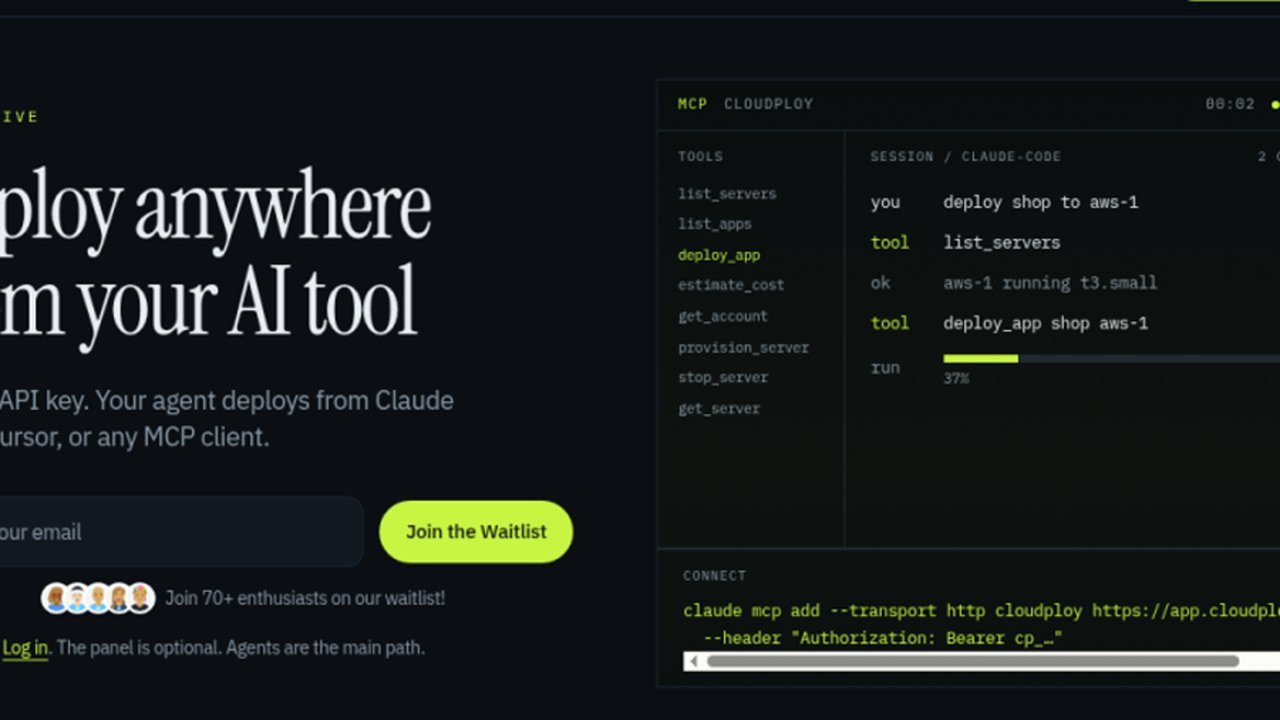
CloudPloy automates cloud infrastructure provisioning and application deployments through conversational AI coding assistants and a web control plane. By connecting via the Model Context Protocol, developers can instruct AI agents in Claude Code, Cursor, or ChatGPT to inspect server health, calculate hosting expenses, provision virtual machines, and trigger production deployments without leaving their code editor.
The platform supports flexible hosting architectures through a bring-your-own-server model alongside automated cloud provisioning. Users can connect any Linux server running Ubuntu or Debian over SSH, or attach their personal AWS accounts through scoped IAM roles and temporary security credentials. The deployment engine uses Nixpacks to detect programming languages and build containers for Node.js, Python, Go, Rust, Ruby, Java, PHP, and Deno stacks without requiring manual Dockerfile configuration.
Routine DevOps overhead is automated during deployment cycles, including reverse proxy configuration, automated SSL certificate issuance, environment variable encryption, and domain routing. Because the control plane separates management fees from compute consumption, teams retain complete ownership of their server infrastructure without vendor lock-in or inflated compute markups.
Screenshots (1)
Features
- Deploy from Claude Code, Cursor, or any MCP client
- Bring your own Ubuntu/AWS server or provision Hetzner/DigitalOcean/AWS at cost
- Built-in reverse proxy routing, automated SSL certificate issuance, and custom domain configuration
- Automated multi-language builds via Nixpacks for Node.js, Python, Go, Rust, Java, and PHP without custom Dockerfiles
Use Cases
- Deploying web applications directly from IDE terminal prompts inside Cursor or Claude Code during active development
- Connecting existing budget VPS instances to a central dashboard without paying markup on raw compute resources
- Launching microservices across personal AWS accounts while maintaining strict security boundaries with IAM roles
- Running automated container builds for polyglot repositories without maintaining dedicated Docker build pipelines
Verified facts
Checked by the StackLedge team.
FAQ
How do AI coding assistants interact with CloudPloy?
Users connect the CloudPloy MCP to MCP-enabled tools like Cursor or Claude Code using an API access token. The AI assistant can then list active servers, calculate workload costs, provision new infrastructure, and execute application builds directly via natural language commands.
What happens to deployed applications if a paid subscription lapses?
Because connected servers run within your own cloud account or third-party VPS provider, applications remain online and operational. Lapsing subscription plans only affect control plane management features, not the underlying server processes.
What languages and frameworks are supported for automatic builds?
The platform uses Nixpacks to auto-detect and containerize applications written in Node.js, Python, Go, Rust, Ruby, Java, PHP, and Deno, alongside static websites and pre-configured deployment templates for Laravel and WordPress.
Are compute costs included in the subscription fee?
Subscription plans cover the CloudPloy control plane and MCP tooling. Compute resources on servers you connect yourself are paid directly to your hosting provider, while CloudPloy-provisioned cloud instances are billed at raw provider cost without markup.
Similar tools
More in Developer Tools

Orisift
Orisift is a developer API for phone, email, IP, and domain validation with evidence-backed risk signals and one shared credit balance

Egmatic
Egmatic is a coming-soon no-code editor and engine for creating and publishing 2D games across five platforms

Kitset SEO Launch Kit
Kitset SEO Launch Kit creates SEO titles, meta descriptions, SERP previews, robots rules, sitemap entries, and starter schema markup
Discussion (0)
Log in to join the discussion.
No comments yet.